
Hotel passport and ID scanners: what to capture at check in, and how
A hotel ID scanner reads the MRZ and printed fields of a passport or ID card and fills the guest register, instead of a receptionist typing them. No law we read requires a scan, but many require hotels to record a short list of details from foreign guests: the Schengen Convention, the UK Hotel Records Order, Spain within 24 hours, Germany for one year. Capture those fields, tell the guest, keep the portrait out, and pick a desk device, a tablet or online check in by volume.
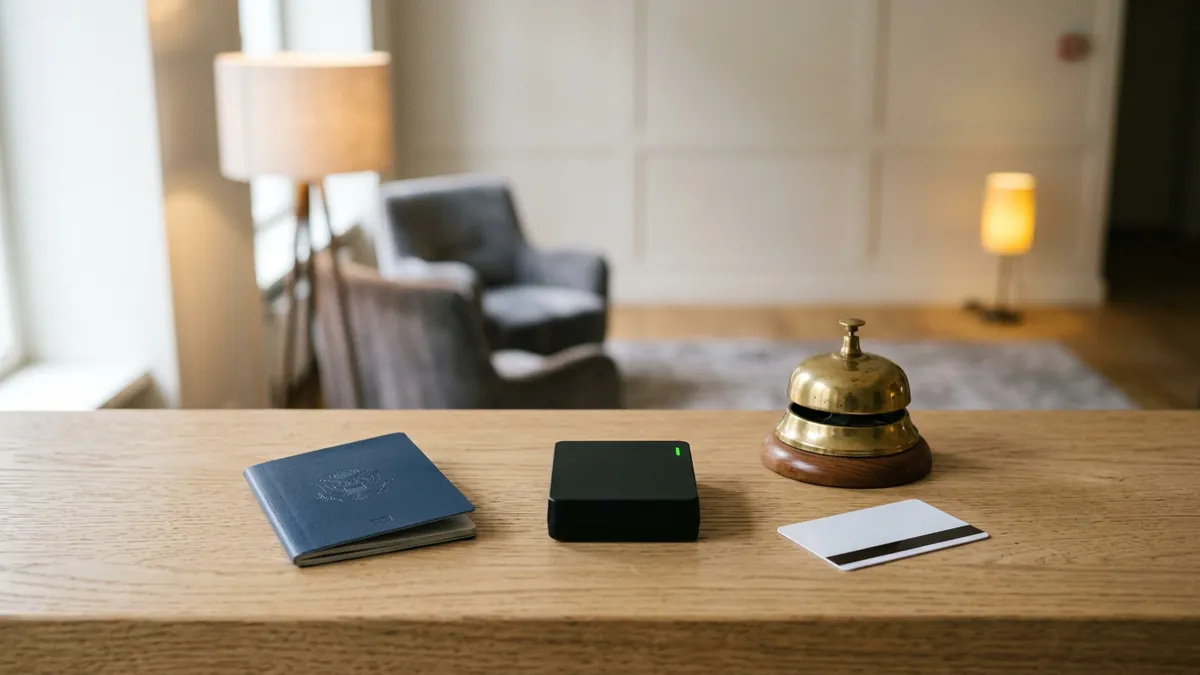
What a hotel ID scanner actually does
A hotel ID scanner reads the guest's passport or ID card and fills the registration record, so the front desk stops typing names, dates of birth and document numbers by hand. It is not one kind of product. The phrase covers three set ups that do the same job with very different costs: a desk device wired to the reception computer, a tablet or phone whose camera reads the document, and an online check in form where the guest uploads a photo before arrival.
Behind every set up the same two readings happen. The scanner reads the machine readable zone (MRZ), the two or three lines of letters, digits and chevrons at the bottom of a passport or on the back of most ID cards, which carry the name, nationality, date of birth, document number and expiry date. Better tools also read the printed fields in the visual zone, which hold what the MRZ leaves out, such as the place of birth or the issuing authority. Our MRZ guide explains the zone line by line.
Say the limit at once: a scanner that reads a document does not prove that the person at the desk is its holder. Matching the face to the photo stays a human glance at the counter, unless you buy a separate biometric check.
Do hotels have to scan passports? What the rules ask for
No law we read obliges a hotel to scan a passport. Many laws oblige it to record certain details of foreign guests and to see an identity document. A scanner is simply the fastest way to copy those details without typos. The obligations differ by country, and the details below come from the official texts, read on 12 November 2026.
| Country | Who is recorded | What the hotel records | How long it is kept |
|---|---|---|---|
| Schengen area (Convention, Article 45) | Foreign guests, including citizens of other EU states; accompanying spouses, minors and members of travel groups are excepted | A registration form completed and signed by the guest, identity confirmed with a valid identity document | Kept for, or forwarded to, the competent authorities under national law |
| United Kingdom (Immigration (Hotel Records) Order 1972) | Every guest aged 16 or over | Full name and nationality; for guests who are not British, Irish or Commonwealth citizens, passport number and place of issue, then next destination | At least 12 months, open to police inspection |
| Spain (Royal Decree 933/2021) | Every guest over 14; an adult gives the data of younger children | Name, sex, document type, number and support number, nationality, date of birth, address, phone, email, payment details, stay dates | 3 years; data sent to the authorities within 24 hours |
| Italy (Article 109 TULPS, Alloggiati Web) | All guests | Guest details sent to the local police headquarters (Questura) through the Alloggiati Web service | Sent within 24 hours of arrival, or on arrival for stays under 24 hours |
| Germany (Federal Registration Act, sections 29 and 30) | Foreign guests; foreign spouses, partners and children only as a number | Exclusively: arrival and departure dates, names, date of birth, nationality, address, number of foreign co travellers, serial number of the passport | 1 year from departure, destroyed within the next 3 months |
| France (CESEDA, Articles R. 814-1 and following) | Foreign guests, EU citizens included | An individual police form (fiche individuelle de police) | 6 months, handed to police or gendarmerie on request |
| United States | No federal rule; some cities keep guest registers | Varies by city; Los Angeles asked for a photo ID number and expiry date for some guests | Los Angeles: 90 days on the premises |
Two points stand out. First, the lists are short and closed: the German text says the form contains "exclusively" its eight data points, and none of the texts asks for a copy of the photo page or for the guest's portrait. Second, the US is different: in City of Los Angeles v. Patel (2015) the Supreme Court struck down warrantless police inspection of hotel registers, while saying that the duty to keep a register was not in question.
Rules change and local laws add to them, so treat this table as a starting point and check with your national tourism body or a lawyer before you design the check in flow.
What to capture at check in, field by field
Collect what the law and the stay require, and stop there. Under the GDPR in Europe, every extra field needs its own legal basis. The Spanish data protection authority fined a hotel in the Balearic Islands after it stored a guest's photo taken from a passport scan, a case reported by the check in software vendor Chekin: the scan was lawful, keeping the portrait without telling the guest was not.
| Field | Where the scanner reads it | Needed for |
|---|---|---|
| Surname and given names | MRZ and printed zone | Every register listed above |
| Nationality | MRZ | Deciding whether the foreign guest rules apply |
| Date of birth | MRZ | Spain, Germany, Italy; minors in the party |
| Document type and number | MRZ | UK (non British guests), Spain, Germany |
| Place of issue or issuing state | MRZ (issuing state), printed zone (authority) | UK asks for the place of issue |
| Expiry date | MRZ | Refusing an expired document at the desk |
| Document support number | Printed zone of Spanish ID cards | Spain |
| Home address | Asked from the guest (rarely on a passport) | Spain, Germany, France |
| Portrait photo | Photo page | No register we read; keep it out unless you have a stated reason |
Here is what the scanner sees in the MRZ of the specimen passport published by the International Civil Aviation Organization (ICAO Doc 9303):
P<UTOERIKSSON<<ANNA<MARIA<<<<<<<<<<<<<<<<<<<
L898902C36UTO7408122F1204159ZE184226B<<<<<10
Line one gives the document type (P), the issuing state (UTO, a fictional code) and the name. Line two gives the passport number L898902C3, the nationality UTO, the date of birth 12 August 1974, the sex F and the expiry date 15 April 2012. Each number is followed by a check digit, which lets the software catch a misread character. That one passport fills six of the fields in the table above; the address still has to come from the guest. The MRZ check digit guide shows how those digits are computed.
Desk scanner, tablet or online check in: which set up fits
| Set up | How it works | Good at | Watch out for |
|---|---|---|---|
| Desk ID scanner | A swipe reader or flatbed device next to the reception computer, often sold with a connector to the property management system (PMS) | High volume desks, groups arriving together, fixed workflows | Hardware cost per desk, drivers, a connector per PMS, nothing done before arrival |
| Tablet or phone camera | An app on a device the staff already has takes a photo of the document and reads it | Small hotels, pop up desks, staff moving around the lobby | Glare on the plastic page, cut off MRZ lines, a weaker read in poor light |
| Online check in form | The guest uploads a photo of the document before arrival; the hotel's software reads it | Short queues, late arrivals, self check in and keyless rooms | Blurry phone photos, a second look needed when a read fails, consent and retention to explain online |
Hotels often mix them: online check in for most guests, a desk device or tablet for walk ins and for the guests whose upload failed. Whatever the set up, three things decide whether it saves time. The reader must handle the documents your guests actually carry, which means passports and national ID cards from many countries, not only domestic driving licenses. The data must land in the PMS without retyping. And the failure path must be fast, because a scanner that fails one guest in ten moves the queue rather than removing it.
Most desk devices and PMS connectors are priced on quote, so ask for the total cost per desk per year, connector and support included, and compare it with what the camera of a tablet you already own can do.
Reading documents in your own software
If your check in runs on your own software, or on a PMS that accepts an integration, the reading can be a call to an OCR API rather than a device. Koncile is one of them: you send the photo or scan, it returns the fields as JSON, the MRZ line by line, and a score from 0 to 100 that flags signs that the image was edited after the document was issued. It reads passports and ID cards, front and back, and charges per page, with 20 free credits to test on your own documents. Its limits matter for a hotel: there is no desk hardware, no face match, no liveness and no reading of the passport chip, and a well made physical forgery photographed at the desk can pass. The score is a signal to verify, never an accusation. The passport OCR page shows a full example.
A check in flow that works, in five steps
- Write down what your country requires, from the official text, and the fields your PMS needs. Everything else stays out.
- Tell the guest before the scan what you record, why and for how long, at the desk and in the online form.
- Read the document, check the expiry date and compare the name with the booking. Look at the guest, then at the photo.
- Send or file the register within the deadline: 24 hours in Spain and Italy, on request in France and the UK.
- Delete on schedule: 6 months in France, 1 year in Germany, 12 months in the UK, 3 years in Spain, and never longer than the law or your stated purpose allows.
Frequently asked questions
Frequently asked questions
01Do hotels have to check ID?
In the Schengen area, yes for foreign guests: Article 45 of the Schengen Convention asks hotels to have them sign a registration form and confirm their identity with a valid document. The UK asks every guest aged 16 or over for name and nationality, and passport details from guests who are not British, Irish or Commonwealth citizens. The US has no federal rule; some cities do, and many hotels ask for a photo ID to match the payment card.
02Do hotels need to scan passports of foreign guests?
They need to record certain details and see the document; no text we read requires a scan. Scanning is a faster, more accurate way to copy the details. Keep only the fields the law requires, and tell the guest before you scan.
03What data do hotels get when they scan your ID?
From the MRZ: name, nationality, date of birth, sex, document number, issuing state and expiry date. From the printed zone, some tools also read the place of birth, issuing authority or, on some ID cards, the address. Whether the hotel keeps the portrait depends on its own policy; none of the registers we read asks for it.
04Is it legal for a hotel to keep a copy of my passport?
It depends on the country and the purpose. A register of details is a legal duty in many European countries; a full copy, and above all the photo, needs its own justification under the GDPR. A Spanish hotel was fined for keeping a guest's photo from a passport scan without telling the guest.
05How long do hotels keep guest ID data?
As long as the national rule says, then it should be deleted: 6 months in France, 1 year after departure in Germany, at least 12 months in the UK, 3 years in Spain. Los Angeles asked for 90 days.
06What is the best ID scanner for a hotel?
The one that reads the documents your guests carry and writes into your PMS without retyping. A desk device suits busy front desks; a tablet app suits small hotels; online check in moves the reading before arrival. Ask for a test on real foreign passports and ID cards, not only on domestic driving licenses.
07Can a hotel ID scanner spot a forged passport?
Some devices check security features under ultraviolet or infrared light, and the MRZ check digits catch misread or badly copied numbers. Software that reads a photo can flag edited images, but neither replaces a trained look at the document and the guest. A score or alert is a reason to look closer, not proof.
08Can guests scan their own passport before arrival?
Yes, through an online check in form or app that takes a photo of the document. The hotel's software reads it and fills the register; the desk then only confirms the guest and hands over the key.
Sources
- Convention implementing the Schengen Agreement, Article 45, EUR-Lex, read on 12 November 2026)
- The Immigration (Hotel Records) Order 1972, legislation.gov.uk, read on 12 November 2026
- Real Decreto 933/2021, BOE, read on 12 November 2026
- Alloggiati Web, Polizia di Stato, read on 12 November 2026
- Bundesmeldegesetz, section 29, read on 12 November 2026
- Bundesmeldegesetz, section 30, read on 12 November 2026
- CNIL, fiche individuelle de police for foreign guests, read on 12 November 2026
- City of Los Angeles v. Patel, 576 U.S. 409 (2015), Cornell LII, read on 12 November 2026
- Chekin, Is it legal to scan a guest's ID card or passport?, read on 12 November 2026
- ICAO Doc 9303, Machine Readable Travel Documents
Read a guest's passport from a photo
Create a Koncile account and run a passport or an ID card through extraction and the fraud analysis. 20 free credits, no card, for professional use.
Create a free Koncile accountTalk to an expert
Documents are deleted after analysis. Face match, liveness and chip reading are not part of the service.